
An Eighteen-Hour Settlement Check Before You Scale
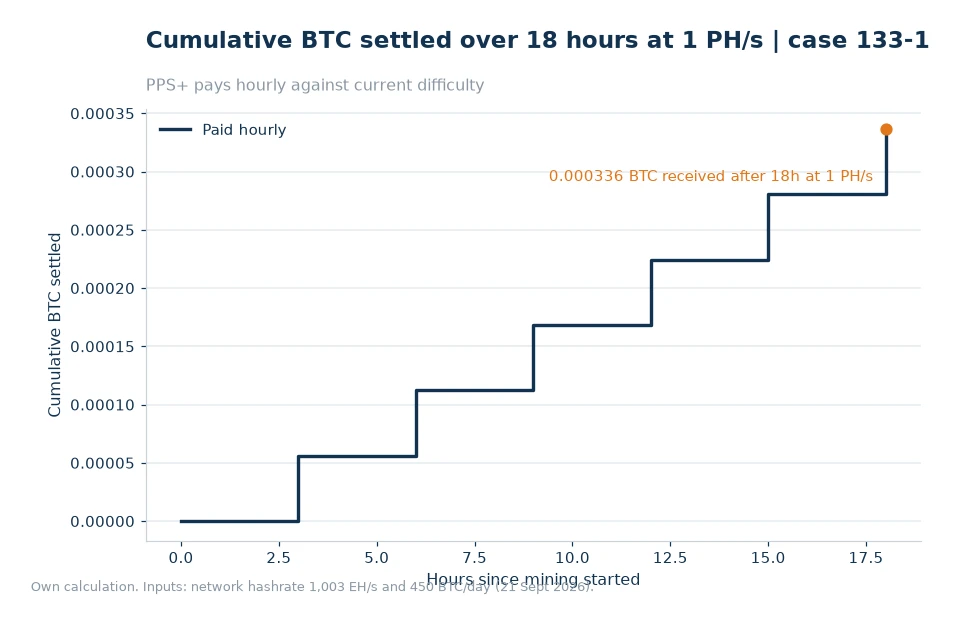
Adding machines multiplies whatever the account is already doing, including its mistakes. Eighteen hours is enough to see the settlement pattern three times over: at 1 PH/s the wallet gains 0.00033645 BTC across that window, worth $28.50 at $84,692, in steps of 5.608e-05 every three hours. Run the check while the fleet is still small and the cost of a wrong assumption is still low.

Key takeaways
- Eighteen hours at 1 PH/s produces 0.00033645 BTC, or $28.50 at $84,692.
- Three-hour checkpoints should read 5.608e-05, 0.00016823, 0.00028038 and 0.00033645.
- A scale-up check tests account plumbing, not hardware luck, so the expected numbers are known in advance.
- An error found with one machine costs one machine's output; the same error with six costs six times as much.
Why eighteen hours is the right length for a scale-up check
A full day is the obvious window, but it is longer than the decision needs. Eighteen hours spans a working day and a night, covers at least three reading points, and finishes before the next hardware delivery in most cases. It is short enough to run while a single machine is still the only thing on the account, which is exactly when a mistake is cheap to correct.
The number is also convenient arithmetically. Eighteen hours is three quarters of a day, so the expected total is three quarters of the daily figure. At 1 PH/s that means 0.75 × 0.00044861 = 0.00033645 BTC. Having a fraction that can be checked mentally makes the window easy to repeat on later occasions without recalculating from scratch.
What the first three hours tell you
The first checkpoint is the most valuable one because it arrives soonest. After three hours the wallet should hold 5.608e-05 BTC. If it holds nothing, the account is not receiving credits, and the cause is almost always configuration rather than the pool. If it holds roughly half the expected amount, one of two things happened: the machine started late, or part of its hashrate is not being attributed to the account.
A third possibility is subtler and more expensive: the credit arrives correctly but into a different account than the one being watched. That happens when a firmware update resets the pool URL or when a machine is configured from an old template that still carries yesterday's worker name. The result is a machine that looks healthy on its own screen while its shares land somewhere the owner is not checking.
Both cases are worth investigating before the next machine arrives, because neither fixes itself. A late start is benign if it was a deliberate power-on delay; unattributed hashrate is not, and it usually points at a worker name, an algorithm selection or a secondary coin setting. Three hours is enough time to see the difference and still act on the same day.
Settlement is what you are testing, not luck
Under PPS+, the block-reward component settles hourly against current difficulty, so the expected credit is known before the run begins. That makes the check a test of plumbing rather than of fortune. If the pool were settling under PPLNS, the same window would produce a lumpy result and the test would need a longer horizon before it meant anything.
The ViaBTC Crypto Wallet is where the check is actually read, and its running balance is what makes the arithmetic simple: credits only, no transfers, no conversions. Anything else in the ledger during the window turns a clean test into an accounting exercise, so keep the eighteen hours free of other activity if you can.
The distinction matters when the numbers come in low. A miner running PPLNS might reasonably wait for more blocks before drawing a conclusion; a miner running PPS+ has no such excuse, because the hourly rate is fixed by difficulty. That is one practical argument for keeping the default scheme during a scale-up, even if a different scheme is planned for later once the routine is established.
Do not withdraw in the middle of the check
A withdrawal during the window adds a debit that has nothing to do with settlement, and the balance at the next checkpoint will be lower than the arithmetic predicts. That is not a fault, but it destroys the comparison. Worse, the transaction may take time to confirm, so the debit and the arrival can sit in different parts of the ledger and produce a temporary balance that looks wrong in both directions.
Leave the coins alone for eighteen hours and the test needs no reconciliation. If a withdrawal is unavoidable, record its amount and time and subtract it from the checkpoint before comparing; a note in the same file as the readings is enough. The general rule is worth keeping beyond this test: when you are measuring a flow, do not also move the stock.
Four readings inside one day
Three-hour intervals divide the window into six equal parts, and the four checkpoints below are enough to see whether the staircase is even.
| Reading | Balance | Dollar value | Part of 18-hour total |
|---|---|---|---|
| 3 hours | 5.608e-05 | $4.75 | 16.7% |
| 9 hours | 0.00016823 | $14.25 | 50.0% |
| 15 hours | 0.00028038 | $23.74 | 83.3% |
| 18 hours | 0.00033645 | $28.50 | 100% |
Worked example
Work from the hourly rate and confirm that each checkpoint is a simple multiple of it.
- Daily output per TH/s: dividing 450 by 1,003,000,000 gives 4.4865e-7 BTC.
- A thousand terahashes therefore produce 0.00044861 BTC a day.
- Hourly: 0.00044861 ÷ 24 = 0.00001869 BTC a day, which is 1.869e-05 per hour.
- Three hours: 3 × 1.869e-05 = 5.608e-05 BTC, or $4.75.
- Nine hours: 9 × 1.869e-05 = 0.00016823 BTC, half the window and $14.25.
- Eighteen hours: 18 × 1.869e-05 = 0.00033645 BTC, and 0.00033645 × 84,692 = $28.50.
- If the next five machines match the first, the same window would produce 6 × 0.00033645 = 0.00201870 BTC, about $170.97.
The multiplier in the last line is the reason for doing the check at all. Every configuration error is also multiplied by six, and every hour of unexplained downtime becomes six hours of lost credit. A single machine's odd result is a curiosity; a fleet's odd result is a budget problem.
Frequently asked questions
Why eighteen hours rather than a full day?
Because it is three quarters of a day, so the expected total is simply 0.75 × 0.00044861 = 0.00033645 BTC at 1 PH/s, and it finishes inside one working cycle with three useful checkpoints.
What should the first three hours show?
5.608e-05 BTC, or $4.75; a zero balance points at account configuration, while roughly half the expected amount suggests a late start or unattributed hashrate.
Does a low reading always mean a problem?
Under PPS+ it does, because hourly credits follow difficulty rather than luck; under PPLNS a short window can legitimately vary, which is why the check is easier to interpret on the default scheme and why a short reading should never be used on its own to rank one scheme against another, however tempting the comparison looks.
Scale after the numbers agree, not before
Run the eighteen-hour check, compare the four readings with the table, and only then order the next batch of machines. Keep the readings in a note with the date, because the same check repeated after the expansion should produce six times the total; if it does not, the difference is the expansion's first real cost and the clearest evidence you will get before the next invoice arrives. The ViaBTC App keeps the balance visible while the check runs, and the Collateral-Pledged Loans page describes a funding route if the expansion needs capital before the new machines have produced their first full day.
Sources: ViaBTC wallet, app, finance and pricing pages for settlement frequency, the listed 4% and the funding steps[1]. Figures read on 21 Sep 2026: 1,003 EH/s network, 3.125 BTC per block, 144 blocks daily, BTC at $84,692. Dated 24 October 2026; credits assume continuous uptime.